


Syria’s New Oligarchic Islamist Minority
Caught in the crossfire of the ongoing US-Israeli escalation against Iran, as bits of intercepted missiles rain down along with spring thundershowers, Syrians once again find themselves at the heart of a precarious and shifting regional landscape where the fall of Bashar al-Assad’s regime was merely one chapter in a broader series of transformations reshaping the Middle East. Yet with the tyrant’s era now over, a more urgent set of questions emerges: What exactly is the nature and identity of the new ruling order? Who is really pulling the strings from behind the scenes? And can these newcomers–whose policies seem to run counter to Syrian aspirations–actually meet the needs of a people longing for genuine liberation after decades of oppression and injustice?
These forces, the strongest of which was Hay at Tahrir al-Sham (HTS), led by Ahmad al-Sharaa under the nom-de-guerre “Abu Muhammad al-Julani,” arrived at the Syrian capital from their stronghold in the northwestern province of Idlib just hours after Assad and his senior leaders fled the country. Less than eight weeks later, on January 29, 2025, a group of these all-male Sunni factions convened in the Presidential Palace in Damascus to anoint al-Sharaa the interim president of Syria. This “Syrian Revolution Victory Conference” claimed to have transformed its participants from warlords of one rural corner of Syria to the heads of a civil government for all Syrians. But their first year of rule has revealed the extent of the contradictions between their ideological ambitions and the complexities of managing the state and society. This is because all the cadres of HTS, who divvied up among themselves the sovereign ministerial positions– political, economic, military and security– believe the sectarian system of governance they established in Idlib is both ideal and possible to replicate and apply to a unified Syria.
How did HTS rule their Idib statelet?
A defining feature of HTS’s rule is its ideological evolution. It originated from Jabhat al-Nusra, the former Syrian affiliate of al-Qaeda, and throughout its rule of Idlib, HTS demonstrated a form of ideological adaptation and pragmatism towards its areas of control and towards the international community. Under “al-Julani,” the group strategically distanced itself from transnational jihadism to focus on what it called “Syrian Jihad.” In 2015, after routing the Free Syrian Army–composed of defectors from the regime’s army and local fighters–the group established its military dominance over Idlib by systematically eliminating its rivals and by defeating or absorbing other major Islamist rebel factions. To moderate its public image, it also suppressed more extreme factions such as Hurras al-Din, and cooperated with the US-led international coalition in its successful targeting of ISIS’s leadership, included the operation that killed the organization’s head, Abu Baker al-Baghdadi.
Establishing a monopoly on organized violence, the fundamental feature of HTS’s rule, created an atmosphere of fear to ensure the population’s compliance and prevent the re-emergence of internal rivals. Having done this, HTS regarded themselves as the governing authority of a “Sunni entity” in Idlib province with nearly three and half million residents, half of them displaced from other rebellious areas. (A small number of religious minorities, mainly Druze and Christians, mostly elderly, remained in the province; the rest were Sunni Muslims.) Their talk of a “Sunni entity,” which Al-Jolani used repeatedly from 2016 on, was part of an effort to rally Sunni Muslims nationwide, who comprise over two-thirds of Syria’s population, to back their dictatorial Jihadist rule in Idlib. However, the term faced widespread criticism and was rejected by the majority of Sunni Syrians both inside and outside Idlib, and by the moderate Syrian Islamic Council, based in Istanbul, whose scholars have now become part of Damascus’s new authorities.
In late 2017, HTS formed the “Salvation Government” (Hukumat al-Inqadh) to serve as its civilian administrative wing. This framework enabled it to uphold its jihadist identity, a political concept adopted by Jihadi groups aims to impose their rule based on their specific interpretation of Sharia law by force. This government assumed responsibility for day-to-day governance, providing the illusion of a division between military and civic roles. This civilian government managed a centralized judicial system–based on its own interpretation of Sharia law—oversaw a complex civil registry and administered the distribution of international humanitarian aid, a lifeline for Idlib’s residents.
Crucially, its rule in Idlib was underpinned by a war economy. It controlled strategic border crossings with Turkey and levied taxes on goods that were the province’s economic lifeline. This revenue funded its administration and military. Several human rights organizations such as Syrians for Truth and Justice, and press monitors such as the Syrian Observatory for Human Rights, have documented HTS’s involvement in property seizure and monopolies on key commodities. Its relationship with the local business community was thus both symbiotic and coercive; businessmen operated under HTS’s protection and regulation and contributed to a fragile economic ecosystem that benefited HTS.
This rule was fundamentally shaped by the overarching role of Turkey, which maintained a significant military presence in Idlib as a security guarantor for the region in partnership with Russia and Iran. As the junior partner in this arrangement, HTS implemented Turkey’s demands regarding border security and operations against other extremist groups. It also repeatedly withdrew from rebellious areas in eastern and southern Idlib such as Maarat al-Numn, Saraqeb, and Kafranbel, handing them over to the Assad regime at Turkey’s behest. Far from being a sovereign, stable power, without being propped up by Turkey and an international humanitarian “aid” economy, HTS would have failed to govern even Idlib. Now, it is failing to govern all of Syria because it is applying the same economic policies it did in Idlib, under quite different conditions.
How is HTS ruling all of Syria?
Now the new rulers have traded military fatigues for bankers’ suits and joined Trump’s “global” anti-ISIS coalition. But this doesn’t mean they have become capable of adopting a Syrian national project based on modernity. Their main paradox is that they uphold a sectarian Islamist project, representing themselves as the Sunni rulers of a Sunni Arab majority in a country that is religiously, ethnically and tribally diverse. They bill themselves as a just contrast to the Assad regime, which they condemn as the tyranny of a minority, referring here to the Alawites. Both parts of this equation are inaccurate. The Assad regime was totalitarian and exploited various societal distinctions to tighten its control—and the new rulers do the same. On the one hand, they deceive the majority by positioning themselves as their representatives. On the other hand, they stir up resentment among minorities, who have come to see themselves as excluded from participation in governance and decision-making. This leaves all Syrians excluded from democratic participation in governance.
One example of this sectarian double standard is Ghazal Abdo Salman, a twenty-year-old Alawite student who was expelled from the University of Latakia over allegations that she posted social media contents inciting Alawites against the authorities over the ongoing violations they face. Meanwhile, dozens of students across various university campuses openly incited violence against Alawites and Druze. Videos posted to their social media accounts show them cursing and calling for the killing of these communities, yet they have not been held accountable in any way by the authorities.
Another example of religious discrimination is the ongoing harassment and killing of Alawites with impunity after most Alawite fighters agreed to disarm in January of 2025. A year ago, this violence drove a group of Alawites loyal to the former regime to launch an armed insurgency targeting a public security patrol and Sunni civilians. Their uprising was quelled within hours, but government forces, allied factions, and tribal and jihadist militias retaliated with a three-day massacre of Alawite civilians.
Fearing a similar fate, Druze factions in As-Suwayda refused to disarm. This prompted the authorities and their loyalist social media influencers to escalate their sectarian rhetoric against the Druze–branding them infidels–and to mount an attack on As-Suwayda in July of 2025 under the pretext that they were carrying weapons outside state control. This ended with yet another massacre, this time of Druze. Israel then bombed a few factions allied with the authorities, and claimed this action was protecting the Druze, though this intervention came a day late and did nothing to prevent the killings. Since then, As-Suwayda, led by a Druze sheikh with notable Israeli backing, has declared its total secession from Damascus. This move involved the tit-for-tat expulsion of hundreds of tribal civilians seen as loyalists from Druze areas, and the expulsion of hundreds of Druze by government troops who occupied the now-empty villages of the western countryside. In both cases, this sectarian security approach thrust two religious figures–two sheikhs—into the role of leaders of rebellions against the authorities. This reveals how the new rulers’ own Sunni-Islamist project has, in turn, generated non-Sunni sectarian spin-offs.
Their treatment of both Sunni Arab Syrians and “other” Syrians from Druze and Alawite communities makes it clear that the new rulers in Syria lack any democratic foundation. Rather, the constitutional declaration issued on 13 March 2025 essentially established one-man rule following a superficial two-day national dialogue orchestrated by the authorities. Al-Sharaa heads the government, which includes few ministers from outside HTS, among them only one woman. In fact, however, HTS sheikhs control ministerial decisions and the entire state bureaucracy. They have also established bodies reporting directly to the interim president, such as the Land and Sea ports authority, the Sovereign Wealth Fund and the Development Fund. Municipalities, unions and Parliament are all appointed by the interim president directly or indirectly. And these decisions are made with zero transparency.
These authorities show no concern for the populace, treating them with the same condescension they exhibited in Idlib. They have undermined transitional justice in order to impose its own narrative over Syrian sacrifices and have reconciled with war criminals and former regime businessmen without public trials. While these Assad cronies have been granted individual clemency—and the freedom to continue business as usual–no laws protect public freedoms, press freedom, or political parties. As a result, a campaign of violence, including killings and the kidnapping of women, continues to target Alawites, in which the perpetrators continue to operate with impunity. While the authorities are not yet engaging in widespread systematic repression–aside from the two major massacres mentioned above–this is largely because they do not fully control Syrian territory and lack genuine international legitimacy, despite significant support from regional actors and the West, particularly the Trump administration. Following his lead, most western economic sanctions on Syria have been lifted. In exchange for legitimacy and consolidation of power, Al-Sharaa and his group have signaled their readiness to make sweeping sovereign concessions in return– such as normalization with Israel without restoring full sovereign rights.
This is the “Idlib model” that Al-Sharaa and his comrades believe will save and restore all of Syria from the depredations of the former regime. On a national scale, the “Idlib model” means pursuing a crude neoliberal policy of shrinking the state, abandoning remaining subsides for citizens and national products, and aggressively seeking investments that benefit a new oligarchic class composed of the same HTS leaders and their relatives who profited in Idlib. Having found themselves positions of power to fill their pockets in the capital, HTS wasted no time in imposing an austerity regime on everybody else. They immediately lifted subsides on basic goods like bread and fuel, then drastically raised electricity prices to levels unaffordable for most Syrians, 90% of whom live below the poverty line.
The upshot is that the new authorities have nothing to offer the vast majority of Syrians, millions of whom are displaced, their homes destroyed. In the absence of real modernizing projects, to justify their authoritarian and immiserating policies they distract the public with sectarian rhetoric, stoking Sunni fears of minorities and exaggerating the threats of separatist projects or an ISIS resurgence while threatening minorities with their exclusionary sectarian practices. This approach that treats the country as spoils of war run as a privately-owned investment firm and billed as an Islamist caliphate will not deliver stability and peace to Syrians whose needs remain immense and unmet.
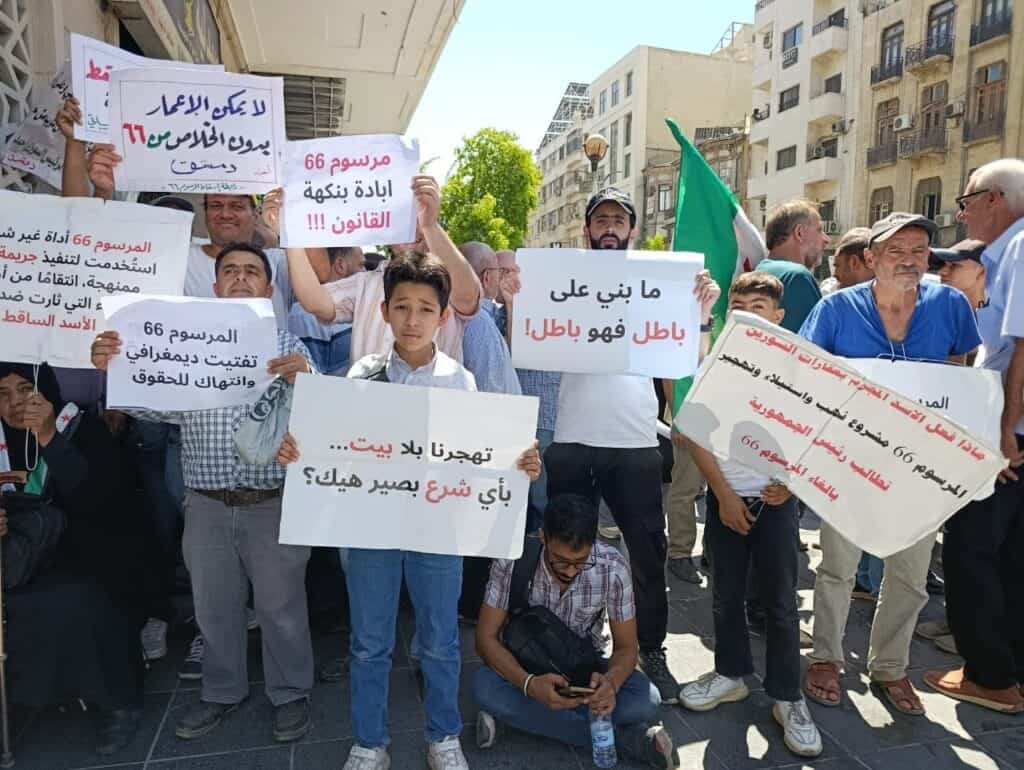
No surprise, then, that since the start of this year, popular protests have erupted across Syria in response to deteriorating living conditions. In the north and northwest, teachers in the Idlib and Aleppo countryside staged a near-total strike over salary reductions. In Damascus, citizens took to the streets to protest the newly introduced electricity tariffs, vowing to refuse to pay their exorbitant electricity bills; another demonstration denounced the forced implementation of Marota City, a development scheme built on land the Assad regime confiscated by decree. In Deir ez-Zor in the east, anger has mounted over the arrest of veterans of 2011 anti-regime protests while armed thugs that served the Assad regime have re-emerged and not been brought to justice. Elsewhere, protests have broken out against monopolistic practices in land transport, fuel distribution and other sectors.
It is ironic, as public discontent grows louder, that al-Sharaa claims to have been radicalized by the second Palestinian intifada. Now he seems to be falling in line with Trump’s vision for Gaza, but in Damascus.

Rania Mustafa is Syrian political activist and freelance journalist specializing in opinion articles and political analysis who publishes in a wide range of Syrian and Arab newspapers and online platforms.